Modern industrial buyers no longer evaluate rubber belts based only on price and availability. Reliability, consistency, durability, and technical performance are now critical decision-making factors. In highly competitive industries, manufacturers that fail to maintain strict quality standards often struggle with product failures, customer complaints, and damaged reputations. This is why quality control has become one of the most important factors in world-class rubber belt manufacturing. A strong quality system ensures that every belt performs consistently, meets technical specifications, and withstands real operating conditions. From raw material inspection to final product testing, quality control standards influence every stage of production. Manufacturers that invest in robust quality systems are better equipped to deliver reliable products, reduce defects, and support long-term customer confidence.
This article explores the quality control standards that define world-class rubber belt manufacturing, explains why they matter, and highlights the processes that distinguish high-quality manufacturers from lower-cost competitors.
Why Quality Control Matters in Rubber Belt Manufacturing
Rubber belts operate in demanding industrial environments where failure can lead to significant downtime, safety risks, and financial losses.
Poor quality belts often result in:
- Premature cracking
- Excessive stretch and creep
- Delamination
- Uneven wear
- Reduced power transmission efficiency
- Unexpected downtime
These issues are rarely caused by a single defect. In many cases, they stem from inconsistent materials, poor manufacturing controls, or inadequate testing.
World-class rubber belt manufacturing depends on strong quality control systems that identify potential problems before products reach the customer.
The Role of Quality Standards in Manufacturing Consistency
Quality standards provide a structured framework for controlling production and ensuring consistency.
Without standardized processes, manufacturers face:
- Variation between production batches
- Inconsistent product performance
- Difficulty tracing defects
- Higher rejection rates
Quality standards create repeatable procedures that help ensure every belt meets the same technical requirements.
In world-class rubber belt manufacturing, consistency is often just as important as performance.
ISO Standards in Rubber Belt Manufacturing
International standards play a major role in defining manufacturing quality.
One of the most widely recognized systems is ISO 9001, which focuses on quality management processes.
ISO 9001 certification demonstrates that a manufacturer has systems in place for:
- Process control
- Documentation
- Corrective action management
- Supplier evaluation
- Customer feedback handling
While ISO certification alone does not guarantee product quality, it provides an important foundation for world-class rubber belt manufacturing.
Industry-Specific Standards for Rubber Belts
Beyond ISO systems, rubber belt manufacturers often follow industry-specific technical standards.
Common standards include:
- DIN standards for dimensional and performance consistency
- RMA standards for belt tolerances and testing
- ISO standards for tensile strength and elongation
- ASTM standards for rubber material properties
These standards help ensure that belts meet globally recognized benchmarks for performance and durability.
Raw Material Inspection and Supplier Quality Control
Quality begins long before production starts.
Rubber belt performance depends heavily on the quality of raw materials such as:
- Rubber compounds
- Tensile cords
- Reinforcement fabrics
- Adhesives and bonding agents
World-class manufacturers inspect incoming materials to verify:
- Material composition
- Tensile strength
- Dimensional accuracy
- Moisture content
- Contamination levels
Strong supplier quality control reduces the risk of defects later in the manufacturing process.
Rubber Compound Testing and Verification
Rubber compounds determine key belt characteristics such as flexibility, heat resistance, abrasion resistance, and chemical durability.
Before production begins, manufacturers often test compounds for:
- Hardness
- Tensile strength
- Elongation
- Compression set
- Aging resistance
These tests ensure that the rubber compound matches the intended application requirements.
In world-class rubber belt manufacturing, compound consistency is essential for maintaining predictable performance.
Tensile Cord Quality and Dimensional Stability
Tensile cords are the structural backbone of rubber belts.
Their quality directly affects:
- Belt stretch
- Load capacity
- Fatigue resistance
- Long-term dimensional stability
Manufacturers test cord materials to verify:
- Tensile strength
- Elongation characteristics
- Adhesion to rubber compounds
- Uniformity across production batches
Poor cord quality is one of the leading causes of premature belt failure.
In-Process Quality Control During Production
World-class rubber belt manufacturing relies on continuous monitoring during production.
In-process quality control includes:
- Monitoring material temperatures
- Checking layer thickness
- Verifying cord placement
- Inspecting molding accuracy
- Controlling curing times
Real-time process control reduces variation and helps prevent defects before they become permanent.
Dimensional Accuracy and Tolerance Control
Belts must meet strict dimensional tolerances to fit properly and perform reliably.
Critical dimensions include:
- Width
- Length
- Thickness
- Groove profile
- Pitch accuracy
Even small dimensional errors can cause:
- Poor pulley fit
- Increased vibration
- Uneven wear
- Reduced efficiency
World-class manufacturers use precision measuring tools and automated inspection systems to maintain tight tolerances.
Curing and Vulcanization Quality Control
Vulcanization is one of the most important stages in rubber belt manufacturing.
Incorrect curing conditions can lead to:
- Weak bonding
- Poor flexibility
- Surface cracking
- Reduced fatigue resistance
Manufacturers control vulcanization through:
- Precise temperature monitoring
- Controlled pressure application
- Accurate curing time management
Consistent vulcanization is essential for achieving reliable belt performance.
Final Product Testing Standards
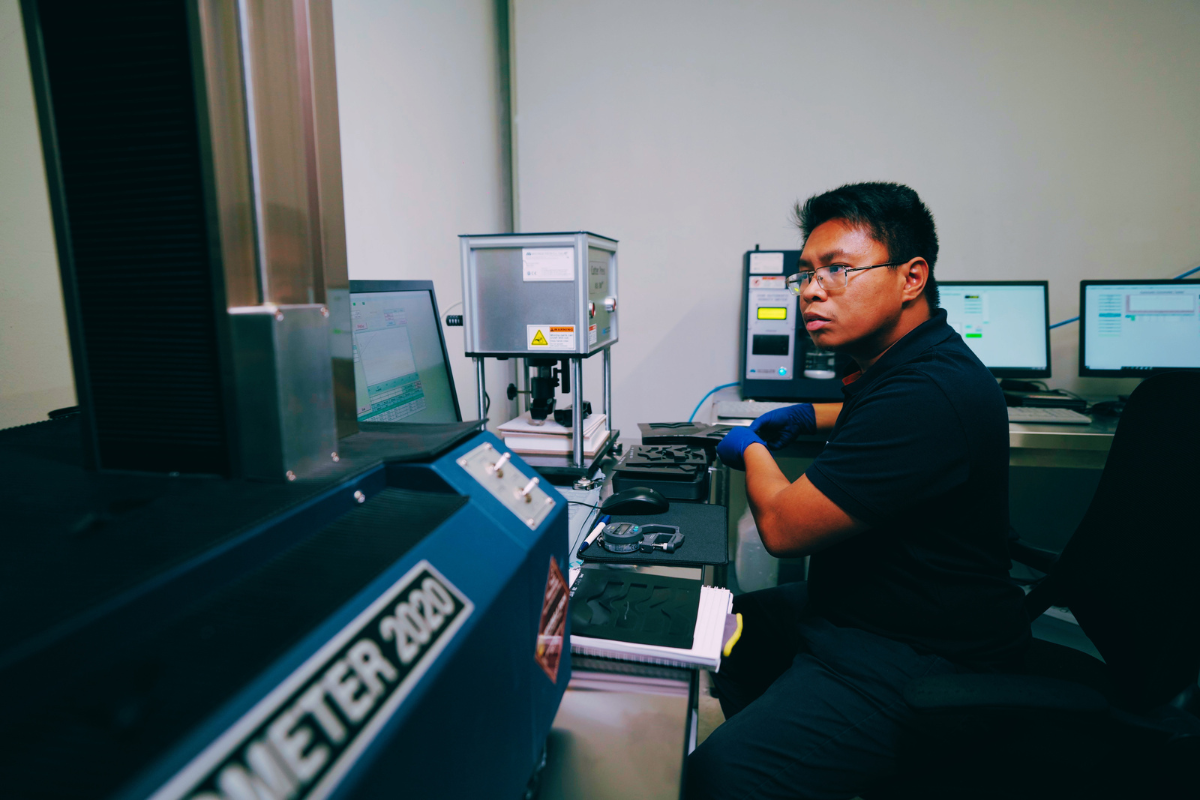
Before shipment, finished belts undergo final testing to verify performance.
Common tests include:
- Tensile strength testing
- Elongation testing
- Adhesion testing
- Fatigue testing
- Heat resistance testing
- Oil resistance testing
These tests help confirm that products meet both customer requirements and industry standards.
Fatigue and Endurance Testing
Rubber belts are often subjected to repeated loading, bending, and temperature changes.
Fatigue testing simulates real operating conditions to evaluate:
- Resistance to repeated flexing
- Long-term dimensional stability
- Crack resistance
- Service life expectancy
Manufacturers that conduct extensive fatigue testing are better able to predict field performance.
Heat, Oil, and Chemical Resistance Testing
Industrial belts are frequently exposed to harsh operating environments.
Testing for heat, oil, and chemical resistance helps ensure belts can withstand:
- High operating temperatures
- Lubricant exposure
- Chemical contact
- Harsh environmental conditions
These tests are particularly important for automotive, HVAC, and industrial process applications.
Traceability and Batch Identification
Traceability is a key characteristic of world-class manufacturing.
Manufacturers should be able to trace every belt back to:
- Raw material batches
- Production dates
- Machine settings
- Operator records
- Inspection results
Traceability improves quality control by making it easier to identify and resolve problems quickly.
Statistical Process Control and Data Monitoring
Many leading manufacturers use statistical process control (SPC) to monitor production quality.
SPC helps identify trends such as:
- Variation in material thickness
- Changes in tensile strength
- Dimensional inconsistencies
By analyzing production data continuously, manufacturers can detect problems before they lead to defective products.
Quality Audits and Continuous Improvement
Quality control is not a one-time activity.
World-class manufacturers regularly perform:
- Internal audits
- Supplier audits
- Customer feedback reviews
- Process improvement projects
Continuous improvement helps maintain competitiveness and ensures that quality systems evolve with market requirements.
The Role of Automation in Quality Control
Automation is increasingly important in rubber belt manufacturing.
Automated systems improve quality by:
- Reducing human error
- Increasing measurement accuracy
- Improving process consistency
- Accelerating defect detection
Automation supports more reliable production and tighter quality control.
Customer Expectations and Quality Assurance
Customers increasingly expect manufacturers to provide:
- Technical documentation
- Test reports
- Material certifications
- Traceability records
Strong quality assurance practices build trust and strengthen long-term customer relationships.
Common Signs of Weak Quality Control
Manufacturers with poor quality systems often experience:
- High rejection rates
- Frequent warranty claims
- Inconsistent dimensions
- Product failures in the field
These issues increase costs and damage reputation.
Long-Term Business Benefits of Strong Quality Standards
World-class rubber belt manufacturing delivers benefits such as:
- Higher customer satisfaction
- Lower defect rates
- Reduced warranty costs
- Improved brand reputation
- Stronger market competitiveness
Quality control is not simply an operational expense. It is a long-term investment in reliability and business growth.
Conclusion
Quality control standards define the difference between ordinary and world-class rubber belt manufacturing. From raw material inspection to final product testing, every stage of production influences belt performance, durability, and customer satisfaction.
Manufacturers that invest in strong quality systems, advanced testing, and continuous improvement are better positioned to deliver reliable products in demanding industrial markets. In an industry where consistency and performance are critical, world-class quality control is not optional—it is essential.