Selecting the right drive system requires a thorough understanding of HTD vs STD timing belt engineering, particularly in industrial applications where torque transmission, positioning accuracy and operational reliability are critical. Although both belt types provide synchronous power transmission, their tooth geometry, load distribution, engagement characteristics and pulley requirements differ.
Industrial machinery increasingly demands consistent performance under variable loads, frequent acceleration, continuous operation and demanding environmental conditions. Consequently, selecting a timing belt based solely on pitch, width or nominal dimensions can lead to premature wear, positioning errors and unexpected downtime.
Engineers must evaluate the complete drive system, including tooth geometry, tensile cord construction, installation tension, pulley compatibility and operating conditions. Furthermore, procurement teams must consider product consistency, manufacturing quality and long-term supply reliability.
At Universal Rubber Belt Manufacturing, we manufacture industrial power transmission belts in Dubai, UAE, supporting distributors, equipment manufacturers and industrial businesses with solutions designed for demanding operating environments.
This technical guide examines the engineering differences between HTD and STD timing belts, their respective performance characteristics and the factors industrial professionals should consider when specifying synchronous drive systems.
1. Why Tooth Geometry Matters in Industrial Timing Belt Performance
Tooth geometry plays a fundamental role in determining how a synchronous drive transfers mechanical power. Unlike friction-based transmission systems, timing belts rely on positive engagement between belt teeth and corresponding pulley grooves.
As a result, the interaction between these components directly influences torque capacity, mechanical efficiency, vibration and operational stability.
Understanding Load Distribution Across Belt Teeth
When an industrial timing belt transmits torque, several teeth engage with the driving pulley simultaneously. However, the transmitted load does not necessarily distribute equally across every engaged tooth.
Factors affecting load distribution include:
- Tooth profile geometry
- Tensile cord stiffness
- Rubber compound properties
- Pulley manufacturing tolerances
- Belt installation tension
- Pulley diameter
- Number of engaged teeth
- Operating torque
- Dynamic loading conditions
An appropriately engineered tooth profile helps distribute forces across the engagement region while limiting excessive localized stress.
Conversely, unsuitable tooth geometry or incorrect pulley engagement can increase stress concentrations. Over time, these conditions may contribute to tooth deformation, fabric deterioration and fatigue-related failures.
The Evolution of Curvilinear Timing Belt Profiles
Traditional industrial timing belts commonly use trapezoidal tooth profiles. These designs remain suitable for numerous established industrial applications.
However, curvilinear and modified-curvilinear tooth profiles offer alternative engagement characteristics for more demanding synchronous drives.
HTD and STD timing belts represent two important developments in synchronous power transmission engineering. Their tooth forms address different design considerations involving mechanical engagement, load transfer and dynamic behavior.
The international standard ISO 13050:2022 – Synchronous Belt Drives establishes principal characteristics for metric-pitch curvilinear synchronous belts and corresponding pulleys across several profile systems.
Understanding these profile systems allows engineers to make more informed decisions when specifying industrial transmission components.
2. HTD vs STD Timing Belt: Tooth Profile and Load Distribution
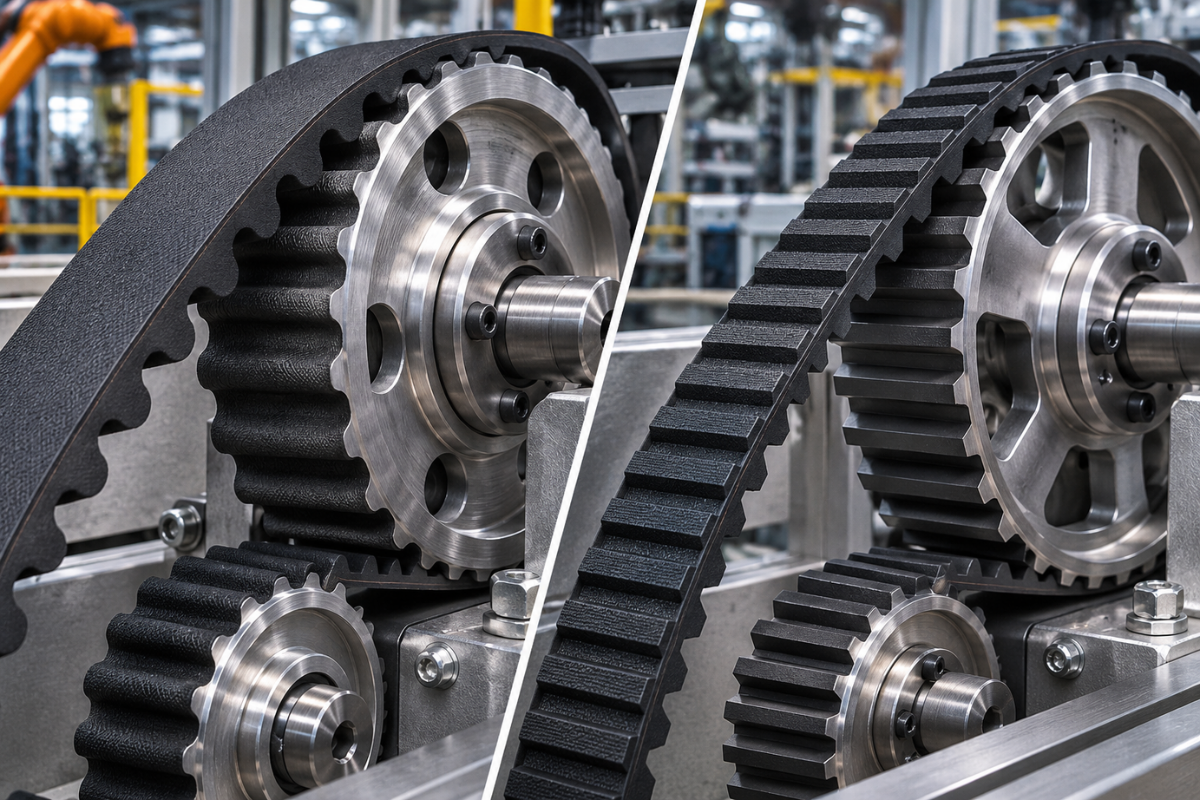
The most important distinction in an HTD vs STD timing belt comparison is the geometry of the belt teeth and their interaction with pulley grooves.
Although both profiles use curved tooth forms, their detailed contours and engagement characteristics differ.
HTD Timing Belt Tooth Geometry
HTD stands for High Torque Drive. The profile incorporates rounded teeth designed to support substantial mechanical loads through positive engagement.
The curvilinear design can help distribute forces more effectively around the tooth compared with certain traditional trapezoidal configurations.
Important engineering characteristics of HTD timing belts include:
- Rounded tooth geometry
- Positive pulley engagement
- suitability for high-torque applications
- Resistance to mechanical tooth loading
- Compatibility with dedicated HTD pulley systems
- Suitability for continuous industrial operation when correctly specified
HTD timing belts are commonly considered for industrial machinery where power transmission and dependable synchronization take priority.
Typical applications include processing machinery, machine tools, textile equipment and industrial mechanical drives.
Explore Universal RBM’s High Torque Drive timing belt range for available industrial product options.
STD Timing Belt Tooth Geometry
STD stands for Super Torque Drive. These belts incorporate a modified-curvilinear tooth profile with geometry that differs from conventional HTD designs.
The relationship between tooth flanks, groove shape and clearance affects how the belt enters and exits pulley engagement.
Depending on the specific drive configuration, STD profiles may offer favorable characteristics for applications requiring smooth engagement, controlled positioning and dependable torque transmission.
Important engineering considerations include:
- Modified-curvilinear tooth geometry
- Controlled tooth-to-pulley interaction
- Suitability for cyclic mechanical loading
- Potential for favorable positioning characteristics
- Compatibility with dedicated STD pulleys
- Performance dependent on correct installation and system design
Engineers should evaluate these characteristics alongside application-specific load requirements rather than assuming one profile is universally superior.
Discover Universal RBM’s Super Torque Drive timing belt range for industrial synchronous drive applications.
Comparing HTD and STD Timing Belt Characteristics
| Engineering Parameter | HTD Timing Belt | STD Timing Belt |
|---|---|---|
| Full Name | High Torque Drive | Super Torque Drive |
| Tooth Geometry | Curvilinear | Modified-curvilinear |
| Power Transmission | Positive engagement | Positive engagement |
| Torque Capacity | Product and application dependent | Product and application dependent |
| Tooth Engagement | Rounded tooth interaction | Modified tooth-flank interaction |
| Positioning Accuracy | Dependent on complete drive design | Dependent on complete drive design |
| Pulley Compatibility | Dedicated HTD profile | Dedicated STD profile |
| Common Applications | Industrial machinery and power drives | Industrial machinery and controlled-motion drives |
| Belt Selection | Based on manufacturer ratings | Based on manufacturer ratings |
The comparison demonstrates why engineers must examine more than the nominal belt designation when selecting a synchronous drive.
3. Tooth-Flank Stress and Mechanical Load Sharing
An effective HTD vs STD timing belt evaluation must consider how mechanical forces transfer through individual teeth.
During operation, the driving pulley applies tangential forces to the belt. The belt subsequently transfers these forces through its tensile members and engaged teeth.
Tooth-Flank Contact and Stress Concentration
Tooth-flank geometry determines the location and distribution of contact forces between the belt and pulley.
When contact occurs over an unsuitable region, localized pressure can increase. Consequently, repeated loading may accelerate tooth wear or contribute to fatigue.
Engineers should assess several variables when evaluating tooth stress:
- Pulley groove geometry
- Tooth engagement depth
- Belt tooth stiffness
- Tensile cord elongation
- Operating load variation
- Contact surface condition
- Manufacturing tolerances
Both HTD and STD profiles aim to support effective torque transfer through curved engagement surfaces. Nevertheless, actual stress distribution depends on the detailed belt construction and operating conditions.
The Role of Tensile Cord Construction
The tensile cord provides the primary longitudinal load-carrying structure within an industrial timing belt.
Its stiffness and dimensional stability influence how the belt distributes mechanical forces across engaged teeth.
Excessive elongation can modify the effective engagement relationship between the belt and pulley. Consequently, individual teeth may experience uneven loading.
Engineers should therefore consider tensile cord construction together with tooth geometry rather than treating the profile as the only performance variable.
Rubber compound selection, tooth-facing materials and manufacturing consistency also influence the long-term reliability of the drive.
For further technical information, read our guide to timing belt reliability engineering and dynamic loading.
4. Ratcheting Resistance and Installation Tension
Ratcheting represents a significant reliability concern in synchronous belt systems. It occurs when belt teeth disengage from their intended pulley grooves and jump one or more tooth positions.
In industrial equipment, this can cause synchronization errors, process interruptions and mechanical damage.
What Causes Timing Belt Ratcheting?
Common contributing factors include:
- Insufficient installation tension
- Excessive transient torque
- Inadequate pulley wrap
- Too few engaged teeth
- Incorrect belt profile
- Pulley misalignment
- Worn pulley grooves
- Excessive belt deformation
- Incorrect belt width
- Unsuitable drive sizing
Although tooth geometry influences engagement stability, neither HTD nor STD belts can compensate for fundamentally incorrect drive design.
HTD vs STD Timing Belt Ratcheting Resistance
When comparing HTD and STD profiles, engineers should evaluate how each belt maintains engagement under both steady-state and transient loading.
The relevant engineering considerations include tooth depth, flank geometry, installation tension and pulley engagement.
Applications involving frequent starts, sudden braking or reversing loads require particular attention. These operating conditions can create temporary forces that exceed the normal steady-state demand.
Therefore, a belt selected solely according to nominal operating power may prove unsuitable when exposed to repeated torque peaks.
Manufacturers’ application-specific ratings and installation requirements should guide final selection.
Why Correct Installation Tension Matters
Timing belts require an appropriate installation tension to maintain dependable engagement.
Insufficient tension may allow the belt to disengage under load. Conversely, excessive tension can increase shaft loads and place unnecessary stress on bearings and tensile cords.
Maintenance teams should use the tension measurement method recommended for the specific drive.
Depending on the equipment, suitable methods may involve sonic tension measurement, force-deflection measurement or another manufacturer-approved procedure.
Correct installation tension supports both HTD and STD belt reliability while reducing unnecessary mechanical loading throughout the system.
5. Backlash and Positioning Accuracy in HTD and STD Timing Belts
Industrial automation increasingly depends on predictable mechanical movement. Packaging machines, indexing mechanisms and automated production equipment often require consistent positioning throughout repeated operating cycles.
Therefore, backlash deserves particular attention in an HTD vs STD timing belt comparison.
Understanding Backlash in Synchronous Drives
Backlash refers to mechanical lost motion associated with clearance between interacting transmission components, particularly when the direction of torque changes.
In a timing belt system, tooth-to-groove clearance can contribute to backlash. However, additional movement may also result from belt elasticity, pulley mounting tolerances and structural deflection.
Consequently, backlash and elastic positioning errors should not be treated as identical phenomena.
The complete system determines actual positioning performance.
How HTD and STD Profiles Influence Positioning
HTD timing belts can provide dependable synchronization in correctly engineered industrial drives. Their rounded tooth profiles support positive engagement across a wide range of mechanical applications.
Meanwhile, STD timing belts use a different tooth contour that may provide favorable engagement behavior in certain controlled-motion systems.
However, engineers should avoid assuming that every STD belt provides lower backlash than every HTD belt.
Actual performance depends on:
- Belt and pulley tolerances
- Tooth clearance
- Tensile cord stiffness
- Installation tension
- Applied torque
- Pulley diameter
- Unsupported span length
- Direction reversal frequency
For precision applications, engineers should request measurable positioning and backlash data for the proposed belt-and-pulley combination.
Selecting Timing Belts for Automated Machinery
Applications requiring controlled positioning may include:
| Application | Critical Engineering Requirement |
|---|---|
| Packaging machinery | Consistent process synchronization |
| Robotic mechanisms | Repeatable movement |
| Automated assembly lines | Accurate component positioning |
| Printing machinery | Registration accuracy |
| CNC machinery | Controlled mechanical transmission |
| Indexing equipment | Repeatable angular displacement |
| Textile machinery | Synchronized rotational movement |
Both HTD and STD profiles can be evaluated for these applications. The final selection should reflect the equipment’s specific positioning tolerance and mechanical requirements.
6. Comparing HTD 8M and STD S8M Timing Belts
The comparison between HTD 8M and STD S8M represents a common engineering consideration because both designs have a nominal tooth pitch of 8 mm.
However, identical nominal pitch does not establish pulley interchangeability or equivalent mechanical performance.
Understanding the Difference Between 8M and S8M
The HTD 8M designation identifies an HTD belt with an 8 mm nominal pitch.
Similarly, S8M identifies an S-profile timing belt with an 8 mm nominal pitch.
Although the distance between consecutive teeth is equivalent, the tooth shape and corresponding pulley groove geometry differ.
Engineers must therefore confirm the entire profile designation when specifying replacement components.
| Specification | HTD 8M | STD S8M |
|---|---|---|
| Nominal Tooth Pitch | 8 mm | 8 mm |
| Tooth Profile | HTD | STD / S-profile |
| Tooth Geometry | Curvilinear | Modified-curvilinear |
| Recommended Pulley | Matching HTD 8M pulley | Matching S8M pulley |
| Torque Rating | Manufacturer-specific | Manufacturer-specific |
| Installation Tension | Drive-specific | Drive-specific |
| Direct Interchangeability | Not assumed | Not assumed |
Engineering Calculation Framework for 8M and S8M
When comparing two synchronous drive configurations, engineers can calculate the mechanical operating requirements using established relationships.
The pulley pitch diameter is:
\[ D_p=\frac{z \times p}{\pi} \]
Where:
- \(D_p\) = pulley pitch diameter
- \(z\) = number of pulley teeth
- \(p\) = nominal tooth pitch
Belt linear speed can then be determined using:
\[ v=\frac{\pi D_p n}{60} \]
Where pulley diameter is expressed in metres, rotational speed in revolutions per minute and belt speed in metres per second.
The effective tangential belt force is:
\[ F_t=\frac{2T}{D_p} \]
Where \(T\) represents transmitted torque in newton-metres and pulley diameter is expressed in metres.
For HTD 8M and STD S8M systems operating with the same pulley tooth count and rotational speed, the theoretical pitch diameter and belt speed will be equivalent.
However, these calculations do not establish equal permissible torque, tooth strength or service life.
Engineers must obtain verified product-specific power ratings, correction factors and installation requirements before approving either configuration.
No numerical performance comparison should be published without validated manufacturer data.
7. Pulley Compatibility Between HTD and STD Timing Belts
Pulley compatibility is among the most important practical considerations when purchasing industrial replacement belts.
An incorrect belt-and-pulley combination may appear dimensionally suitable while producing unfavorable engagement conditions.
Can HTD and STD Timing Belts Use the Same Pulley?
Engineers should not assume that HTD and STD timing belts are interchangeable.
Even when two belts share the same nominal pitch, differences in tooth geometry can affect their contact with pulley grooves.
Potential consequences of using an unapproved combination include:
- Incorrect tooth seating
- Concentrated contact pressure
- Increased operating noise
- Premature tooth wear
- Irregular load distribution
- Increased ratcheting risk
- Reduced positioning accuracy
- Unexpected equipment downtime
Only use cross-profile combinations when the relevant manufacturer explicitly approves compatibility.
Identifying the Correct Replacement Belt
Maintenance and procurement teams should collect complete technical information before ordering replacement products.
This should include the existing belt designation, nominal pitch, pitch length, width, profile type and pulley specifications.
The original equipment manufacturer’s part number can also help verify the correct replacement.
Furthermore, engineers should inspect pulley wear before installing a new belt. A worn pulley can negatively affect the operation of an otherwise suitable replacement.
For an overview of available transmission profiles, explore our industrial timing belt product range.
8. HTD vs STD Timing Belt Performance Under Dynamic Loading
Many industrial machines operate under conditions that extend beyond constant-speed mechanical transmission.
Equipment frequently experiences acceleration, deceleration, reversing motion and variable torque. Consequently, engineers must evaluate how timing belts perform throughout the complete operating cycle.
Acceleration and Deceleration Loads
When machinery accelerates, the drive must overcome both the operating resistance and the inertia of rotating components.
During deceleration, the system may experience changing load directions and additional mechanical stresses.
These conditions influence tooth loading, belt tension and pulley engagement.
Therefore, calculating drive capacity using average operating power alone may underestimate the application’s actual requirements.
Peak torque, duty cycle and rotational inertia should form part of the engineering assessment.
Continuous Operation and Repeated Loading
Industrial production equipment may operate continuously or undergo numerous operating cycles throughout each shift.
Repeated loading creates fatigue-related demands on the belt teeth, tensile cords and rubber compound.
Both HTD and STD timing belts require construction characteristics suitable for the intended operating environment.
Engineers should consider material fatigue resistance, temperature exposure, mechanical alignment and product-specific speed limitations when selecting a belt for continuous operation.
Hysteresis and Heat Generation
Rubber compounds experience cyclic deformation as timing belts enter and exit pulley engagement.
This deformation generates internal energy losses through hysteresis, which can contribute to heat generation.
Operating speed, pulley diameter, belt construction and environmental temperature influence the resulting thermal conditions.
Excessive heat can accelerate material degradation and reduce long-term reliability.
Consequently, thermal performance should form part of the engineering evaluation for demanding industrial applications.
9. Industrial Applications of HTD and STD Timing Belts
Understanding the practical applications of each profile helps maintenance engineers and procurement managers identify suitable drive configurations.
However, industry classifications alone cannot determine the correct belt. Equipment specifications remain the primary selection criteria.
Manufacturing and Production Machinery
Manufacturing facilities depend on synchronized mechanical systems to maintain production consistency.
Timing belts can support mechanical transmission between equipment components while maintaining the required speed relationship.
Both HTD and STD profiles may be suitable depending on machine speed, torque demand and positioning requirements.
Typical applications include material processing equipment, automated assembly machines and industrial production machinery.
Packaging and Food Processing Equipment
Packaging equipment often requires controlled movement across multiple mechanical components.
Synchronous drive systems can support repeatable machine operation and coordinated processing cycles.
In food processing environments, engineers must also evaluate exposure to cleaning chemicals, moisture and temperature variation.
Where direct food-contact or hygienic requirements apply, the belt must have the appropriate product-specific approval. Standard industrial construction alone does not establish food-contact suitability.
Machine Tools and Industrial Automation
Machine tools and automated industrial equipment frequently combine mechanical power transmission with positioning requirements.
An HTD vs STD timing belt assessment should therefore consider mechanical stiffness, torque variation and permissible positioning error.
Applications with frequent direction changes require particular attention to tooth clearance, tension and elastic displacement.
Textile and Printing Machinery
Textile and printing equipment often relies on precise synchronization between rotating assemblies.
Incorrect belt engagement or pulley misalignment can affect process consistency and product quality.
Consequently, these applications benefit from correctly specified belt profiles and consistent maintenance procedures.
10. Where Classical Timing Belts Still Make Engineering Sense
Although HTD and STD profiles provide important advantages for numerous synchronous drive applications, classical trapezoidal timing belts remain relevant.
Replacing an established belt system with a newer profile does not automatically improve mechanical performance.
Classical Timing Belt Applications
Classical Timing Belts, commonly referred to as CTB, remain suitable for various legacy industrial systems and established machinery configurations.
Their advantages may include compatibility with existing equipment, straightforward replacement requirements and suitability for applications operating within their specified mechanical ratings.
Maintenance teams should avoid unnecessary pulley modifications when the original system performs reliably.
Evaluating CTB Against HTD and STD Profiles
A profile conversion should follow a complete engineering assessment.
Relevant considerations include:
- Existing pulley compatibility
- Required torque capacity
- Equipment operating speed
- Replacement component availability
- Modification costs
- Maintenance requirements
- Expected operational benefits
Universal RBM offers Classical Industrial Timing Belts alongside HTD and STD profiles, supporting different industrial transmission requirements.
11. How to Select the Right Industrial Timing Belt
Selecting between HTD and STD timing belts requires a structured engineering process.
The appropriate profile depends on the application rather than a general ranking of belt technologies.
Step 1: Establish Operating Requirements
Begin by documenting transmitted power, shaft speed, operating torque and required speed ratio.
Also identify peak loading conditions, operating hours and the frequency of starts and stops.
This information establishes the mechanical requirements of the proposed drive.
Step 2: Evaluate Pulley Geometry and Available Space
Determine pulley tooth count, pitch diameter, center distance and available installation space.
For replacement applications, confirm the existing pulley profile.
New drive designs should consider appropriate pulley sizes and tooth engagement requirements from the beginning.
Step 3: Determine Positioning Requirements
Applications involving precise movement require additional evaluation of backlash, elastic deformation and mechanical tolerances.
Specify acceptable positioning error rather than relying on general product descriptions.
This approach allows engineers to compare suitable belt-and-pulley systems against measurable performance requirements.
Step 4: Assess Environmental Conditions
Operating environments can significantly affect industrial rubber belt performance.
Consider ambient temperature, airborne contamination, humidity, chemical exposure and nearby heat sources.
For demanding industrial environments, request confirmation of compound suitability and operating limitations.
Step 5: Confirm Technical Specifications With the Manufacturer
Before finalizing procurement, request relevant technical documentation and verified product specifications.
An effective manufacturer consultation should address the belt profile, dimensions, mechanical ratings, installation requirements and applicable operating limitations.
This process helps prevent unsuitable substitutions and reduces uncertainty during equipment maintenance.
12. Common Industrial Timing Belt Failures and Preventive Maintenance
Even correctly selected timing belts require appropriate installation and inspection procedures.
Regular preventive maintenance helps identify developing problems before they result in unexpected production interruptions.
Recognizing Common Timing Belt Failure Modes
| Failure Mode | Possible Contributing Factors |
|---|---|
| Tooth shearing | Overload, ratcheting or insufficient engagement |
| Edge wear | Pulley misalignment or flange interference |
| Tooth surface deterioration | Pulley wear, contamination or incorrect engagement |
| Belt cracking | Material aging, excessive bending or unsuitable temperatures |
| Tensile cord failure | Excessive loading or installation damage |
| Abnormal noise | Incorrect tension, misalignment or incompatible profiles |
| Tooth jumping | Insufficient tension, overload or inadequate pulley wrap |
These symptoms can have multiple causes. Therefore, maintenance teams should investigate the complete drive system before replacing damaged components.
The Importance of Pulley Alignment
Incorrect pulley alignment can create uneven belt loading and excessive edge contact.
Over time, this can contribute to premature wear and reduced mechanical reliability.
Engineers should check both angular and parallel alignment using appropriate measurement equipment.
For additional technical guidance, read our article on rubber belt alignment for high-speed industrial systems.
Establishing a Preventive Maintenance Program
Maintenance teams should develop inspection schedules based on operating conditions, equipment criticality and manufacturer recommendations.
Inspections should cover belt surface condition, tooth integrity, pulley wear, alignment and installation tension.
Before performing inspections or maintenance, personnel must isolate machinery using the applicable equipment safety procedures.
Documenting inspection results also helps identify recurring failure patterns and improve future procurement decisions.
13. Procurement Considerations for Industrial Timing Belts
Technical performance represents only one aspect of industrial belt procurement.
Purchasing teams must also evaluate manufacturing consistency, documentation, product availability and supplier responsiveness.
Why Manufacturing Consistency Matters
Dimensional consistency plays an important role in synchronous drive performance.
Variations in tooth geometry, belt width or pitch length may affect mechanical engagement.
Furthermore, inconsistent construction can introduce uncertainty when replacing belts across multiple machines.
Procurement managers should therefore prioritize suppliers capable of maintaining consistent manufacturing processes and providing appropriate technical information.
Reducing Total Cost of Ownership
The lowest purchase price does not necessarily represent the most economical industrial belt solution.
Total cost of ownership includes acquisition, installation, maintenance, replacement frequency and potential production interruptions.
An unsuitable replacement belt can create expenses that substantially exceed its initial purchase cost.
Consequently, procurement decisions should consider technical suitability and long-term supply reliability alongside pricing.
Supporting Distributors and Industrial Buyers
Industrial distributors require access to clearly identified product profiles and dependable supply arrangements.
Accurate product specifications help distributors recommend suitable replacements while minimizing ordering errors.
Equipment manufacturers and industrial buyers also benefit from direct communication with manufacturing teams when evaluating specific drive requirements.
14. Industrial Timing Belt Manufacturing in Dubai, UAE
Universal Rubber Belt Manufacturing supports industrial businesses, equipment manufacturers, wholesalers and distributors through its power transmission belt manufacturing operations in Dubai Industrial City.
Our industrial timing belt portfolio includes High Torque Drive, Super Torque Drive and Classical Timing Belt profiles.
Manufacturing Solutions for Industrial Applications
Our approach focuses on product consistency, application suitability and dependable industrial power transmission.
Universal RBM operates with ISO 9001, ISO 14001 and ISO 45001 management system certifications, addressing quality management, environmental management and occupational health and safety.
These management system certifications support structured organizational processes. However, individual belt performance and application suitability should always be confirmed through the relevant technical specifications.
Supporting Industrial Businesses Across Regional Markets
As a UAE-based manufacturer, Universal RBM supports procurement teams and distribution businesses seeking regional industrial belt supply solutions.
Our team assists customers with product identification, technical inquiries, bulk purchasing requirements and distribution opportunities.
Whether your application requires an HTD, STD or classical timing belt, selecting the correct configuration remains essential to dependable operation.
Visit Universal Rubber Belt Manufacturing to explore our manufacturing capabilities and industrial power transmission solutions.
Conclusion: Choosing Between HTD and STD Timing Belts
An effective HTD vs STD timing belt comparison extends beyond nominal pitch, tooth shape and catalogue descriptions.
Engineers must consider the complete synchronous drive system, including mechanical loading, pulley compatibility, installation tension, positioning accuracy and environmental conditions.
HTD timing belts provide an established solution for numerous industrial power transmission applications. Meanwhile, STD timing belts offer alternative tooth geometry that may support specific engagement and operational requirements.
Neither profile represents the universally superior choice. The appropriate solution depends on verified mechanical ratings and the needs of the equipment.
For procurement professionals, working with an industrial rubber belt manufacturer can simplify technical evaluation, product sourcing and long-term supply coordination.